
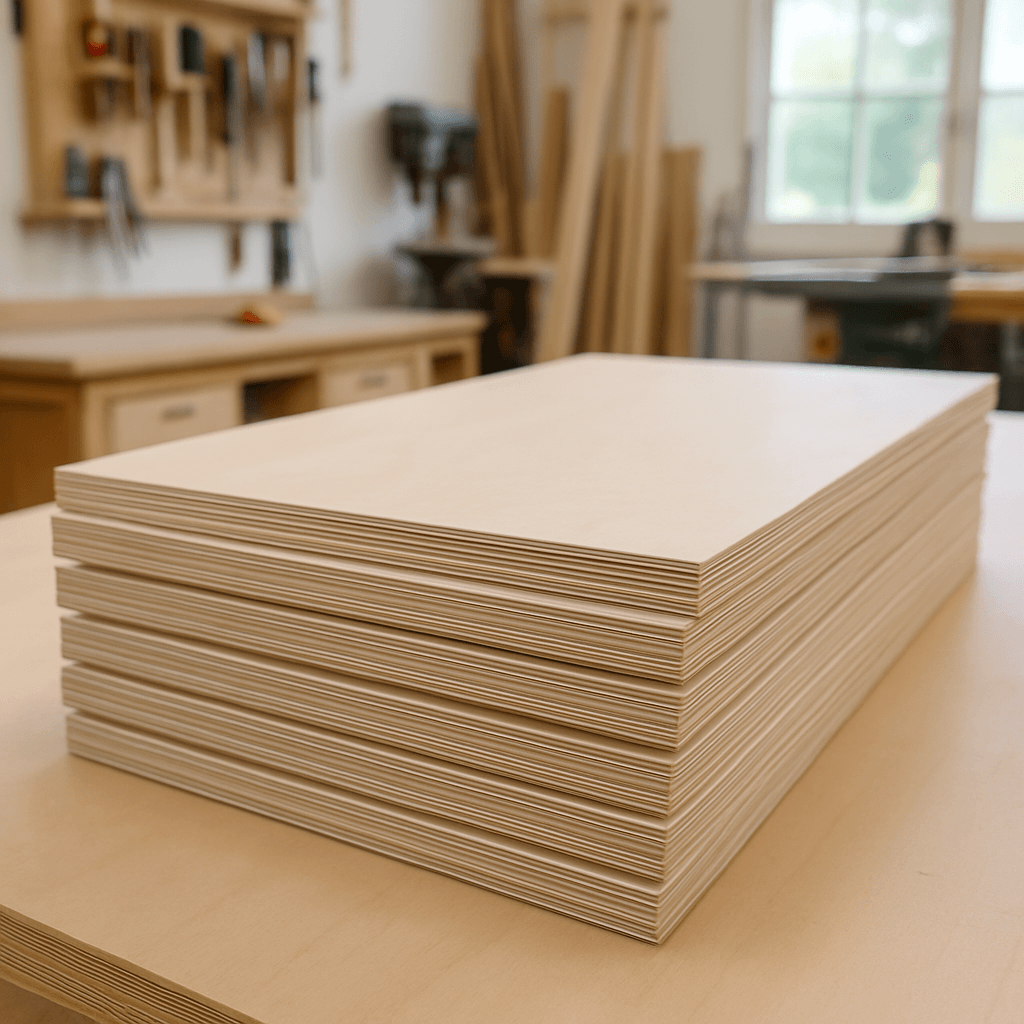
Every furniture manufacturer in New Zealand knows the feeling. The joint is tight, the machining is clean, the door is hung dead square — and then the lacquer goes on and a core void telegraphs through the face like a bruise. The build was never the problem. The panel was.
Furniture plywood is where a premium piece is won or lost. It sets the flatness of your carcase, the crispness of your edge detail, the way a finish sits, and how the piece behaves two winters from now in a Wellington villa or an Auckland apartment. This guide covers what separates furniture-grade panels from general-purpose sheet stock, which options are worth specifying for which components, and the checks that stop a bad pallet reaching your machine centre.
What Actually Makes a Panel “Furniture Plywood”
The term gets used loosely. Plenty of sheet stock will hold a screw and take a hinge, but furniture plywood earns the name on four counts:
- A clean, void-free core. Gaps and overlaps inside the panel are what telegraph through veneer, collapse under clamping pressure, and leave a ragged edge when you expose the laminations as a design feature.
- Tight thickness tolerance. Cabinet construction is a system of repeated joints. A panel that wanders half a millimetre across a pallet turns a perfectly programmed dado into a rework list.
- Flatness that survives storage. A panel that arrives bowed will not machine flat and will not press flat.
- A face grade you can finish. Consistent colour, minimal patching, a sanded surface that accepts stain or clear coat evenly across a whole run.
Structural plywood is engineered to carry load and shrug off weather. It is excellent at that job and largely indifferent to how it looks. Furniture plywood is engineered to be seen, and that changes everything about how it is peeled, graded, laid up and sanded.
The Finish Problem Starts in the Core
Most finish defects that get blamed on the spray booth were baked into the panel long before it arrived. Three culprits account for the majority of them.
Core voids. An unsupported gap under the face veneer has nothing to push back when you sand or press. The face dips, the finish pools, and the defect only becomes visible under gloss.
Density mismatch. Where a hard patch sits against a soft core, the two sand at different rates. You get a subtle hollow that reads as a shadow under raking light — which is exactly how furniture is lit in a showroom.
Unbalanced construction. Plywood stays flat because the layers pull against each other symmetrically. Veneer or laminate one face and leave the other bare, and the panel will cup as the finish cures and the humidity swings. Balanced backing is not an upsell; it is the physics of the panel.
Panel Options Worth Knowing
There is no single best panel for furniture. There is a right panel for each component, and the manufacturers who make money are the ones who mix them deliberately rather than buying one grade for everything.
Birch Plywood
The reference point for premium cabinetry. 100% birch plywood gives you a dense, consistent core through the full thickness, which means clean exposed edges, excellent screw and fitting retention, and a face that finishes beautifully. It runs from 3mm up to 24mm, so the same material can serve drawer bottoms, carcase sides and thick shelving. It is the panel to reach for when the plywood edge is part of the design language.
Where budget matters more than the exposed edge, birch-faced panels on a poplar core deliver the same finishing surface at lower cost and lower weight. A UV-coated version removes the sanding and sealing step entirely for interiors, shop fittings and anything you need out the door quickly.
Poplar Panels
Poplar Elite is the workhorse for weight-sensitive work. It is a light, stable, flat panel in 2400 and 2700 x 1200mm sheets from 3mm to 18mm, bonded with WBP glue, and it machines, glues and bends well. Its real strength is as a substrate: it is an excellent base for bonding veneers or high-pressure laminates, which makes it the sensible core for wardrobe doors, wall panelling and any large surface where every extra kilogram is a kilogram someone has to lift on site.
Veneered Panels
When the brief calls for real timber, a factory-pressed veneered panel beats veneering in-house on consistency and on cost per square metre. American white oak remains the volume seller in New Zealand interiors; European oak, walnut and the wider natural timber veneer range cover the rest. Order enough for the whole job in one hit — veneer is a natural product and batches vary.
Pre-Finished and Laminated Panels
For carcases, wet areas and high-wear surfaces, a finish applied under industrial pressure will outlast anything a workshop can spray. HPL on plywood and the melamine panel range both take the finishing operation off your floor entirely. The trade-off is that you commit to a colour at ordering, so the decision belongs at quoting stage, not at assembly.
Bendy Plywood
Curved reception counters, radiused cabinet ends and drum shapes are laminated up from bendy plywood over a former. Two or three laminations glued and clamped give you a curve that holds its shape permanently, without steam and without the springback that makes kerf-bending unpredictable.
Matching the Panel to the Component
| Component | Typical choice | Why |
|---|---|---|
| Carcase sides and shelves | 15–18mm birch on poplar, melamine or HPL-faced | Stiffness and fitting retention with a finish already on it |
| Exposed-edge cabinetry | 18mm 100% birch | Clean, consistent laminations as a design feature |
| Doors and drawer fronts | Veneered or laminated panel, balanced both faces | Appearance and long-term flatness |
| Drawer bottoms and dust panels | 6–9mm birch or poplar | Light, stable, cheap to machine |
| Curved elements | Bendy ply laminated over a former | Holds the radius with no springback |
| Large wall panels and wardrobe doors | Poplar core, veneered or laminated | Keeps weight and hardware load down |
Six Checks Before You Commit to a Pallet
- Sight the edges. Look down the long edge of several sheets from the middle of the pallet, not just the top one. Voids, overlaps and wandering glue lines are all visible without cutting anything.
- Check thickness across the sheet. Take calliper readings at four corners and the centre. Consistency inside a sheet matters as much as consistency between sheets.
- Lay one flat. A sheet on a level floor should sit down. Any daylight under the middle is bow that will fight you all the way through the build.
- Confirm the glue bond. WBP or equivalent for anything near a kitchen, laundry or bathroom. Interior-only bonds belong in dry furniture and nowhere else.
- Ask about the face grade and the batch. Grade letters vary between origins. What you want to know is how much patching is permitted on the face and whether the pallet came from one production run.
- Talk about repeat supply. If you build the same product line monthly, ask whether the panel will still be there in three months. Reformulating a product around a discontinued panel costs more than the panel ever did.
Working the Material
Acclimatise before you machine. Panels arriving from a cold truck into a heated workshop need a few days flat and stickered to settle. Cutting cold, wet sheets is the fastest route to joints that open up later. Aim to build at a moisture content close to where the furniture will live — roughly 8–12% for most heated New Zealand interiors.
Store flat, always. Sheets leaned against a wall take a permanent bend. Flat on bearers, off the concrete, away from a sunny roller door.
Score the cut on veneered faces. A scoring blade or a shallow scoring pass on the CNC eliminates the tear-out that shows up on the underside of a veneered panel. Sharp tooling and the right feed rate do the rest — burning is usually a feed problem, not a blade problem.
Seal the edges early. Exposed plywood edges drink finish. A thinned sealer coat before the top coats keeps the edge from going darker than the face.
Finish both sides. Whatever goes on the front goes on the back, even where nobody will see it. It is the cheapest insurance against a cupped door.
Sourcing Furniture Plywood in New Zealand
Panel supply in New Zealand is a long way from its source. Most furniture-grade sheet stock is imported, which means the practical questions for a manufacturer are less about the mill and more about what is on the floor here, today.
- Stock depth. Can you get another twenty sheets next week in the same thickness, from the same run, when the client adds a second unit?
- Range in one place. Sourcing birch from one supplier, melamine from another and veneer from a third multiplies your freight, your paperwork and your chances of a colour mismatch.
- Sheet sizes. 2400 x 1200mm suits most cabinetry; 2700mm lengths save a join on full-height wardrobes and tall pantries. Getting that right at design stage removes an entire operation.
- Value-add services. Cut-to-size, custom coating and colour matching move work off your bottleneck machine and onto someone else’s.
- Delivery. Nationwide freight matters if you are building in Auckland and installing in Christchurch.
Plyman stocks the full furniture panel range at 65 The Concourse, Henderson — plywood, melamine, natural timber veneers and high-pressure laminates — with drive-in access, custom coating and colour matching, and nationwide delivery.
Frequently Asked Questions
What thickness of furniture plywood should I use for cabinet carcases?
15mm or 18mm covers most cabinet construction. Use 18mm for wide shelves, tall gables and anything carrying real load; 15mm is fine for smaller carcases and keeps weight down. Drawer bottoms and back panels rarely need more than 6–9mm.
Is plywood better than MDF for furniture?
They solve different problems. Plywood is stronger for its weight, holds fixings far better in the edge, and tolerates moisture better — so it wins for carcases, shelving and anything that will be assembled and reassembled. MDF gives you a perfectly flat, homogeneous surface with no grain, which makes it the better substrate for painted doors and routed profiles. Most furniture manufacturers use both, chosen component by component.
Why does my plywood cup after finishing?
Almost always unbalanced construction or unbalanced finishing. If one face is veneered, laminated or coated and the other is not, the two faces respond differently to moisture and the panel curls towards the sealed side. Finish both faces, and choose panels with balanced layups.
Can furniture plywood be used in kitchens and bathrooms?
Yes, with the right bond and the right detailing. Specify a WBP-bonded panel, seal every cut edge including hardware cut-outs and sink apertures, and keep raw edges away from standing water. For heavy or continuous moisture exposure, step up to a marine-grade panel instead.
What is the difference between 100% birch and birch-faced plywood?
100% birch is birch all the way through, so the exposed edge shows uniform, tight laminations and the panel holds fittings well anywhere. Birch-faced plywood has a birch face and back over a different core — usually poplar — which gives the same finishing surface at lower cost and weight. Choose 100% birch when the edge is visible; choose birch-faced when it is hidden behind an edgeband.
How should I edge exposed plywood?
Three options. Leave it raw and sealed, which suits birch and reads as a deliberate design choice. Apply matching edgebanding for a solid-timber look. Or glue on a solid timber lipping, which is the most durable option where the edge takes knocks — drawer fronts, table edges, shelving in commercial fitouts.
How long should panels acclimatise before machining?
Two to three days flat and stickered in the workshop is a reasonable minimum, longer if the sheets arrived cold or damp. The point is to let the panel reach equilibrium with the environment it will be machined and finished in.
Can I get panels cut to size?
Yes. Cutting to size before delivery saves handling, reduces offcut waste and frees up your panel saw for the work that actually needs your tooling. Talk to the team with your cutting list.
The Panel Is the Product
A client never sees your machining time or your assembly jigs. They see a flat door, a crisp edge and a finish that still looks right in five years. All three of those come out of the panel you unwrapped at the start of the job.
Specifying properly — the right core for the component, a bond that matches the environment, balanced construction on anything that gets a face — costs a little more per sheet and removes an entire category of problems from your workshop. For New Zealand manufacturers competing on quality rather than price, that is the whole argument.
Need to talk through a specification for a run? Call the Plyman team on (09) 282 4897, or come and look at the panels in person at 65 The Concourse, Henderson.