
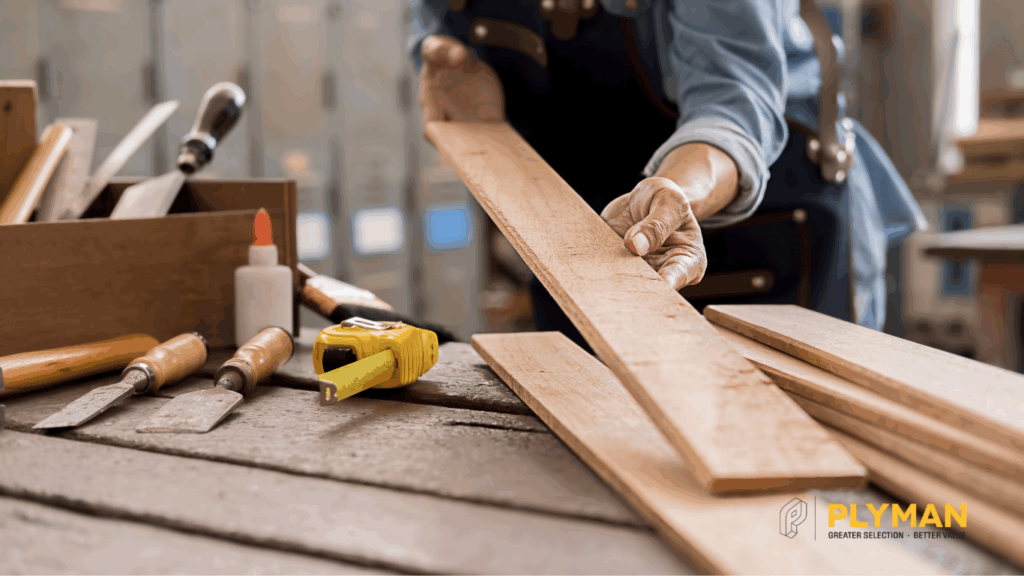

Plywood primarily expands and contracts across its width rather than its length. Cross-laminated veneers reduce movement, but they do not eliminate it. Seasonal changes in humidity can still cause measurable expansion and contraction. When this movement is restrained, stress builds within the panel, leading to surface cracking, joint ridging, or fastener distortion.
A common mistake is fixing plywood too rigidly. Screws driven hard into framing without allowing slip prevent natural movement. Over time, this results in visible fastener marks, buckling, or cracking along joints. Professionals space fixings carefully and avoid locking panels in place, especially on
larger sheets.
Ventilation is another overlooked factor. Plywood installed in enclosed spaces without airflow is exposed to uneven moisture conditions. This often occurs in caravans, cabinetry, and internal linings where one face is sealed and the other is not. Uneven moisture absorption causes cupping or bowing
as one side of the panel moves more than the other.
Finishing practices also affect long-term stability. Sealing only the visible face creates imbalance. Moisture enters through the rear or edges, causing distortion over time. Balanced finishing, where both faces and edges are sealed appropriately, helps regulate moisture movement and extends the life of the panel.
Thickness alone does not guarantee stability. A thicker panel installed incorrectly will still fail. Stability comes from matching the correct plywood grade to the environment and installing it with movement in mind.
At Plyman, advice goes beyond thickness and price. Customers are guided through how plywood behaves over time, not just how it looks on day one.
Understanding movement isn’t overkill. It’s how projects stay flat, clean, and durable for years to come.