
Whether you are a professional cabinet maker, an avid DIY enthusiast, or a digital fabrication expert, the materials you choose fundamentally dictate the success of your project. In the vast world of sheet goods, one material consistently reigns supreme: birch ply.
Renowned for its strength, beautiful finish, and incredible versatility, birch is a powerhouse material that has transformed modern woodworking. But what exactly makes this specific type of wood so highly regarded? From intricate laser crafts to heavy-duty workshop furniture, let’s explore the profound benefits of using birch plywood in your next project.
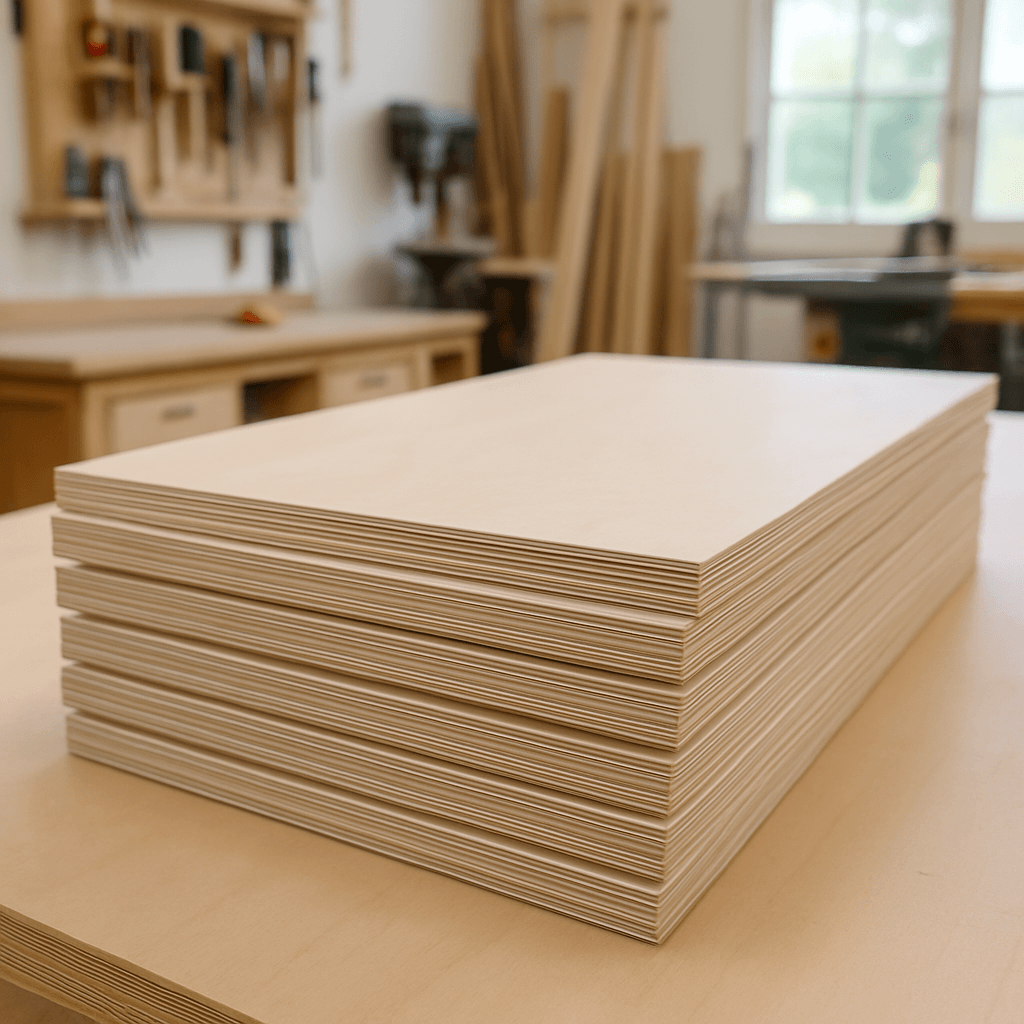
The Anatomy of Quality: What Makes Birch Ply Different?
To understand the benefits of this material, you have to look under the hood—or rather, beneath the surface veneer. Standard plywood is often made with a mix of softwood inner cores, which can contain hidden voids (empty spaces). These voids compromise strength and create ugly gaps when the edges are exposed.
Premium birch panels, however, are manufactured using void-free cross-banded inner layers. Every single layer (or “ply”) in the core is made of solid birch wood. These layers are glued together at alternating right angles. This meticulous construction method is the secret behind the renowned structural integrity of multi-layer laminates. Because there are no empty gaps inside the board, it holds screws exceptionally well, resists denting, and offers a beautiful, solid edge that is frequently left exposed as an architectural feature.
Furthermore, top-tier panels often utilize phenolic resin adhesive bonding during the pressing process. This high-performance glue line not only holds the plies together with immense strength but also contributes to the impressive moisture resistance of marine grade adhesives. While standard birch isn’t inherently waterproof, exterior-grade versions bonded with these robust resins can withstand significant humidity changes without delaminating.
Outstanding Aesthetics and Grading Standards
One of the main reasons makers gravitate toward this material is its clean, bright aesthetic. A natural birch veneer boasts a pale, elegant color with an understated, fine grain. It takes stains beautifully and looks stunning with a simple clear coat of polyurethane or oil.
However, not all sheets are created equal. When purchasing, having Baltic birch grades explained to you is crucial for getting the right material for your budget. The grading system generally uses a two-letter format, referring to the face and the back of the panel.
The gold standard for premium furniture is navigating the B/BB face veneer quality standards:
- B Grade (Face): This is the highest quality. It features a uniform, clear surface with no splices, patches, or prominent knots. It is perfect for cabinet doors or art pieces where the wood grain is proudly displayed.
- BB Grade (Back): This side allows for uniform color patches (small, oval-shaped plugs used to replace knots) and slight mineral streaks. It is perfectly smooth and ideal for the inside of cabinets or the underside of tables.
- CP and C Grades: These are lower grades that allow for more prominent defects, larger patches, and open knots. They are best reserved for structural work, upholstery framing, or rough templates.
Material Face-Off: How Birch Compares to Alternatives
When standing in the lumber aisle, it is easy to get overwhelmed by the options. Let’s do a quick cabinet grade sheet goods comparison to see why birch consistently comes out on top.
Hardwood Veneer Core vs MDF Panels
Medium-Density Fiberboard (MDF) is cheap, heavy, and has a perfectly smooth surface. However, when comparing a hardwood veneer core vs MDF panels, birch is vastly superior in terms of structural strength. MDF sags over time under heavy weight (like on a bookshelf) and turns into a crumbling mess if exposed to water. Birch ply is significantly lighter, boasts superior screw-holding power, and won’t turn into a sponge when introduced to moisture.
Russian Birch vs Maple Sheets
Another common debate among woodworkers is Russian birch vs maple sheets. Both offer a light, closed-grain appearance. However, maple plywood often features a thin, delicate maple face veneer glued over a softer core (like poplar or fir). This makes the maple sheets more prone to tear-out during cutting, and the edges must be hidden. Authentic Baltic/Russian birch is birch all the way through, offering better edge aesthetics and denser, stronger core layers.
The Champion of Precision: CNC and Laser Applications
Digital fabrication has caused a massive surge in the popularity of thin birch panels. If you own a laser cutter, you already know that a 6mm birch ply (or even thinner 3mm sheets) is considered the absolute best wood for laser cutting and engraving.
Why? Because the core layers are free of voids and heavy glue pockets, a laser beam can cut through the material with consistent power. Softwood plywood with voids will cause the laser to flare up, ruining the cut, while heavy glue pockets will stop the laser from penetrating completely. The uniform density of birch ensures clean, crisp, and predictable cuts every single time.
For larger router projects, the density of the wood allows for incredible detail. However, you need to dial in your equipment. Proper CNC routing settings for hardwood panels usually involve using compression bits to prevent tear-out on both the top and bottom veneers. Because birch is a dense hardwood, a slightly lower feed rate combined with a higher spindle speed (compared to routing pine or MDF) will yield glass-smooth cuts that require minimal sanding.

Practical Applications and Workshop Tips
Beyond aesthetics, the practical applications of this material are endless. Here are a few ways to maximize its potential in your shop.
Creating Reliable Workshop Fixtures
Accuracy in woodworking relies on the tools you use. That is why building workshop jigs with stable materials is a non-negotiable rule for professionals. Whether you are crafting a table saw crosscut sled, a router table fence, or a drill press table, the stability of birch ensures your jigs won’t warp, flex, or degrade over time. The dense layers provide a rigid, perfectly flat reference surface that keeps your cuts perfectly square.
Taming the Warp in Thin Sheets
Wood is a natural, hygroscopic material, meaning it absorbs and releases moisture from the air. Preventing warping in thin wood panels—especially in 3mm or 6mm thicknesses—requires proper handling.
- Acclimatization: Always let your sheet goods sit in your workspace for 48 hours before cutting so they can adjust to the room’s humidity.
- Storage: Store thin sheets perfectly flat on the ground with a heavy weight (like an MDF offcut) on top of them. Never lean thin birch against a wall for long periods, as it will inevitably bow.
- Balanced Finishing: If you paint or seal one side of a thin panel, you must seal the other side equally to prevent uneven moisture absorption, which leads to cupping.
Mastering the Edges
Because the cross-banded core is so aesthetically pleasing, many designers choose to leave the edges exposed for a modern, industrial look. If you go this route, the best way to seal plywood edges is to sand them progressively up to 220-grit, wipe away the dust, and apply a few coats of wipe-on polyurethane or hard wax oil. The oil will pop the contrast between the alternating light and dark layers.
If you prefer a traditional solid-wood look, edge banding is your best friend. Applying a real-wood iron-on edge banding completely hides the plies, making your cabinet grade plywood indistinguishable from a solid slab of hardwood.
Sourcing Quality Birch Globally
The demand for high-quality birch spans the globe, and sourcing the right material means understanding international certifications and local suppliers.
For structural and architectural projects, professionals should look for panels that meet the European standard EN 636-2. This specification guarantees that the plywood is suitable for use in humid conditions and that the structural integrity of the bonding will not fail under standard environmental stresses.
For creators in the Southern Hemisphere, finding top-tier materials used to be a challenge, but the market has expanded beautifully. If you are operating down under, searching for premium baltic birch plywood nz has become much easier. Several specialized lumber yards now import authentic panels, ensuring that the high demand for birch plywood nz is met with genuine, void-free products. When sourcing birch wood nz, always ask your supplier about the grading and the core construction to ensure you aren’t being sold a standard hardwood-faced alternative.

What is Euro Birch B/BB? Euro Birch B/BB is a high-quality versatile plywood manufactured from birch veneers that offers superior durability and stability with a light colour and fine grain pattern.
What are the main applications for Euro Birch B/BB plywood? Furniture making, interior design, cabinetry, architectural panels, decorative wall linings, laser cutting, CNC work, vehicle interiors, shopfitting, and precision engineering projects.
What is the density range of Euro Birch B/BB plywood? 600-750 kg/m³
What type of glue is used in Euro Birch B/BB plywood? WBP (Weather & Boil Proof)
What is the formaldehyde content in Euro Birch plywood? ≤ 0.1 ppm (E1 Grade)
What thickness options are available for Euro Birch B/BB? 3mm, 4mm, 6mm, 9mm, 12mm, 16mm, 18mm, 24mm
What are the standard sheet dimensions for Euro Birch plywood? 2440 x 1220mm, 2740 x 1220mm, 3050 x 1220mm
What is the moisture content range in Euro Birch B/BB? 8.0 – 12.0%
What is the internal bond strength of Euro Birch plywood? 0.55 N/mm²
What is the modulus of elasticity for Euro Birch B/BB? 9000 N/mm²
What is the modulus of rupture for Euro Birch plywood? 45 N/mm²
What is the screw holding strength on the face of Euro Birch B/BB? 1200 N
What is the screw holding strength on the edge of Euro Birch plywood? 900 N
What is the bending strength of Euro Birch B/BB? 35 N/mm²
What is the thermal conductivity of Euro Birch plywood? 0.13 W/(m·K)
What is the sound insulation rating of Euro Birch B/BB? 22 dB (Airborne)
What is the thickness tolerance for Euro Birch plywood? ± 0.3 mm
What is the length/width tolerance for Euro Birch B/BB? ± 3 mm/m (Maximum 5mm)
What is the squareness tolerance for Euro Birch plywood? ± 2.0 mm/m
What is the edge straightness tolerance for Euro Birch B/BB? ± 1.5 mm/m
Is Euro Birch B/BB plywood water-resistant? No, it requires appropriate sealing for moisture-prone areas.
What makes Euro Birch B/BB sustainable? It is sourced from responsibly managed European forests and complies with sustainable forestry practices.
What tools are recommended for cutting Euro Birch plywood? Sharp carbide-tipped tools to avoid chipping.
What adhesives are compatible with Euro Birch B/BB? PVA or polyurethane adhesives for strong bonding.
How should Euro Birch B/BB plywood be stored? In a dry, covered area away from direct sunlight, stacked evenly with support to maintain flatness.
What handling precautions should be taken with Euro Birch plywood? Lift carefully to avoid edge damage, use protective gloves, and handle sheets upright for structural integrity.
How long should Euro Birch B/BB sheets acclimate before installation? At least 48 hours in the installation environment.
What finishes can be applied to Euro Birch plywood? Stains, oils, or lacquers for added protection.
How should the Euro Birch B/BB surface be cleaned? With a soft dry cloth or slightly damp cloth if necessary—avoid harsh chemicals or excessive water.
What is the B/BB grade in Euro Birch plywood? A grading that ensures a consistent surface with few natural defects, suitable for both visible and structural applications.
What makes Euro Birch B/BB good for laser cutting and CNC work? The dense, fine-grain structure makes it ideal for intricate cuts.
Why might machining Euro Birch plywood be more challenging? Due to its high density, sharp tools are required for machining.
What is the strength-to-weight ratio like for Euro Birch B/BB? Excellent, making it a reliable choice for various demanding applications.
Can natural wood variation be present in Euro Birch plywood? Yes, natural wood variation may be present and staining or coating may be required for uniformity.
Who supplies Euro Birch B/BB plywood? Botica & Co Pressing Services under the brand name Ultima, a division of The Botica Group.
What is the Euro Birch B/BB supplier’s address? 65 – 69 The Concourse, Henderson, Auckland 0610, New Zealand.
What is the Euro Birch B/BB supplier’s phone number? 09 282 4956
What is the Euro Birch plywood supplier’s email? info@boticagroup.co.nz
What is the Euro Birch B/BB supplier’s website? www.boticagroup.co.nz
Is there a warranty available for Euro Birch plywood? Yes, a warranty is available upon request for additional assurance of reliability.
What should be done to cut edges of Euro Birch B/BB for best performance? Sealing all cut edges is recommended to prolong lifespan and performance.
What core construction feature does Euro Birch B/BB have? Precisely engineered core with minimal overlap ensuring a consistently flat and stable panel.
What environmental benefits does the Euro Birch plywood manufacturing process offer? It uses manufacturing processes designed for lower emissions and efficient use of materials to reduce offcuts and waste.
Conclusion: An Investment in Your Craft
Choosing the right materials is the ultimate form of respect for your own time and effort. While standard softwood plywood or MDF might save a few dollars upfront, the hidden costs – wasted time dealing with tear-out, structural failures, warping, and poor aesthetics—far outweigh the initial savings.
Birch ply offers a unique synergy of beauty, strength, and workability. From the flawless face veneers to the incredibly strong, void-free inner layers, it is a material engineered to help you do your best work. Whether you are dialing in your CNC machine for a batch production run, building heirloom-quality cabinets, or simply upgrading your workshop jigs, investing in premium birch plywood will elevate your projects from good to extraordinary.